
Sometimes Thomas Aquinas is
boring, and sometimes Stephen King is boorish. While the first attempts to
present truth without drama, the latter attempts drama without truth. Wouldn’t
it be nice to have both? Isn’t there a place where theologians and fiction
readers can meet? Happily, we have the following novels, which I’ve curated out
of no other logic than that I found them the best fictional explorations of
Christian themes so far in my short life. I suppose, though, this post itself
should have a better justification than that. So, briefly, here are my reasons.
Reading contemporary literature,
I get the strong impression that authors are shirking their responsibility to
wrestle with realities in a way that makes for growth, spiritual or otherwise.
A while ago Flannery O’Connor, protesting the focus on technique and story
structure in the American MFA programs, said, “We want competence, but
competence by itself is deadly. What is needed is the vision to go with it, and
you do not get this from a writing class.” How much the MFA degree has impacted
modern fiction, I can’t say—though I suspect is has, and drastically. I do
agree, though, with O’Connor’s priorities. Why settle for mere competence, mere
entertainment, mere story, when these things could also serve a greater purpose
than themselves? I’m not talking about didactic, or moralizing, literature. I’m
talking about literature that gives us the excitement of life as a spiritual
excitement.
Simone Weil wrote an essay
entitled “The Responsibility of Writers.” It’s brilliant, but it obviously
forces a mandate on writers that most will refuse.
“The good is the pole towards which the human spirit is necessarily oriented, not only in action but in every effort, including the effort of pure intelligence… The literature of the twentieth century… consists in describing states of the soul by displaying them all on the same plane without any discrimination of value, as though good and evil were external to them, as though the effort towards the good could be absent at any moment from the thought of man. Writers do not have to be professors of morals, but they do have to express the human condition. And nothing concerns human life so essentially, for every man at every moment, as good and evil. When literature becomes deliberately indifferent to the opposition of good and evil it betrays its function and forfeits all claim to excellence.” (The Simone Weil Reader, 289)
Weil gives the example of Proust, who “makes many attempts to analyze non-oriented states of the soul.” His 4,000-page novel In Search of Lost Time is considered one of the best, if not the best, work of literature in the 20th century. Such is the state of critics’ spiritual priorities. I have only read the first volume, Swann’s Way, and it is breathtakingly beautiful; I feel like Keats did about Chapman’s Homer: “Then felt I like some watcher of the skies / When a new planet swims into his ken.” Still, Weil’s incisive comment rings true for me, and I suddenly feel an absence in Swann’s Way of something essential.
In summary of this insight, I
turn to Wayne C. Booth, a writer and critic whose moral sensibility I envy and
who wrote these perfect assessments of what contemporary readers and writers
seem to value in literary fiction:
“To defend the moral intent of the author is in itself no more conclusive than to show that he wanted to write a masterpiece. In this matter, curiously enough, the ‘intentional fallacy’ is committed by many critics who avoid it otherwise: if a novelist’s intentions are ‘serious’ rather than ‘commercial,’ or if he has set out to reveal filth rather than to celebrate nobility, many seem to feel that they should give his work at least some credit, however slovenly its technique may be...” (386).
“We are told again and again that the novelist could not help turning inward to his own private world of values because there was no outer world left to which he could appeal. But even if consensus has declined—something in itself hard to prove, in spite of our ready clichés about it—surely artists must accept some of the responsibility for the decline themselves. If the loss of consensus forced them into private value systems, private myths, it hardly could be said to have forced them into the kind of private techniques I have discussed… One possible reaction to a fragmented society may be to retreat to a private world of values, but another might well be to build works of art that themselves help to mold a new consensus” (The Rhetoric of Fiction, 393).
Hear hear! Without further ado, then, I present ten books that I do think take on these responsibilities of the artist in this fragmented Waste Land of a world. My intention is, I’ll admit, to give those readers about to pick up Eat, Love, Pray, or The Stand, or a John Grisham or Dean Koontz novel, another option. Just as no one should play laissez faire with truth, neither should we play laissez faire with fiction; so accuse me of bias, of prescribing taste, of whatever. No one will be able to deny the connection between fiction and truth after reading just one of the following novels, and seeing that, find something missing in so much of the literature out there.
[Please note—before you get all high strung at the absence of The Brothers Karamazov and The Lord of the Rings—the simple fact that you must get rid of the sun (two suns in this case) in order to see the stars.]
Ten Novels
[1] Franny and Zooey, by J. D. Salinger
This is more than a novel—it is spiritual direction at
its finest. Salinger is a writer who knows
how to dramatize intellectual crises, a writer who can take those truths
we find ourselves indifferent to in the everyday and bring us into that rare
state of exacerbated yearning, hope and vulnerability in which they seem real
again and take on the lustre of immediate consequence. Franny is a university
student and actor on the verge of a breakdown. She is sick of all the ego—the
cloistered, preening, self-affirming university ego—around her. “Sometimes,” she complains, “I think that
knowledge—when its knowledge for knowledge’s sake, anyway—is the worst of all.
I don’t think it would have all got me quite so down if just once in a
while—just once in a while—there was at least some polite little perfunctory
implication that knowledge should lead to wisdom.” I will not spoil the climax.
But the fact that there is a climax in a “novel of ideas” should be indication
enough that this book is worth a read.
 [2] Silence, by Shusako Endo
“Father, have you thought of the suffering you have
inflicted on so many peasants just because of your dream, just because you want
to impose your selfish dream upon Japan?” In Silence, Endo has pulled together all the coarsest questions of
faith and suffering, knotted them into a ball, and thrown them at the reader’s
face. Here we have a Portuguese priest in a foreign country, oppressed by the
feeling of uselessness, dreading the state’s violent anti-religious authorities,
confused at seeing a spiritual master’s apostasy… As we read, Endo shows us the
difference between the solutions that Christ did not bring and the redemption
that he did.
[3] East of Eden, by John Steinbeck
 [4] Wise Blood, by Flannery O’Connor
You can’t have a list of theological novels without
Flannery O’Connor in it somewhere. No other author has spent so long and hard a time
problem-solving the representation of grace in fiction. Grace, indeed, is for her the very point
of fiction: “There is a moment in every great story in which the presence of
grace can be felt as it waits to be accepted or rejected, even though the
reader may not recognize this moment,” she writes elsewhere. In Wise
Blood, O’Connor creates a vehemently anti-Christian character, Hazel Motes and shows us how his being haunted Christ, who darts from “tree to
tree” in the back of his mind, is part of his very integrity. Thus O'Connor dramatizes a journey towards redemption
as only a writer who has masterfully combined both “competence” and “vision”
can.
 [5] Descent into Hell, by Charles Williams
Charles Williams is the lesser-read
member of the Inklings (you know—C. S. Lewis, Tolkien…). The reason? He’s
dense. He’s unconventional. His novels have been described as “supernatural
thrillers.” In this novel, William’s finest achievement, we have Wentworth, a
historian who little by little is damning himself to hell. For Williams, as for
Lewis, that is the only way you end up there: through little and big choices in
which you relinquish your ability to love. But what Williams is doing here is
unique—he’s not a theologian arguing that “making bad decisions can have
eternal consequences”; rather, his aim, as T. S. Eliot puts it, “is to make you
partake of a kind of experience that he has had.” The plot, accordingly, follows
a dream-logic in which breath-taking and haunting passages appear like flashes
in a jungle of meaning; there’s a relentless forward motion, a superfluity
of weighty intention. The reader finds himself wondering, On what level of
reality is this or that event happening? Williams, it is clear, is so attuned
to spiritual truths that he has trouble separating the mundane from the eternal
for us common folk.
On putting this book back on the
shelf, I had the feeling of having met a great and beautiful soul. I would
anticipate our meeting in heaven with excitement but for his being—it is so
easy to forget—a fictional character. Really, this book doesn’t need me to argue for it. Just read the Norman Denny translation.
(As a side note, I don’t know by what convention the title has gone un-translated,
but it really should be called “Outcasts.”)
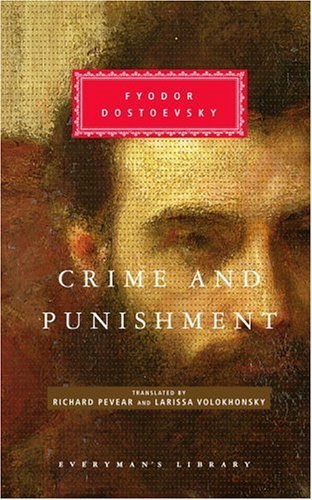
[7] Crime and Punishment, by Fyodor
Dostoyevsky
For a while I had trouble with the idea, which seems so
obviously true to me now, that there was an essential spiritual structure to
the human being—in other words, that there is a “human nature,” that we are created
in such a way that certain things lead to our flourishing while other things
lead to our confusion, our decay, our death. One cannot escape Crime and Punishment without being
convinced of this. One of way of describing the arrogant, self-involved
Raskolnikov is a “spiritual explorer,” a man pushing the limits of what a
human self can mean and do. His murders and his self-concealment can be seen as a forays
into the outskirts of the human spirit, expeditions to discover the limits of
the world of the self. What Raskolnikov finds is a guilt that won’t disappear,
indeed a guilt that strengthens into a light shining on a depth of createdness in
himself that he had not seen before. “The darker the night, the brighter the
stars, / The deeper the grief, the closer is God!” writes Dostoyevsky. Part of
his genius is that he recognized the need for such “negative
revelations” in an age of religious disillusionment. This is why it is inaccurate
to call Dostoyevsky an “existentialist.” He is a storyteller of the life of the
spirit. Crime and Punishment is the
story of Raskolnikov’s discovery of a desire for reintegration, for health, and with it Dostoyevsky shows us what stories can give us that we cannot get elsewhere.
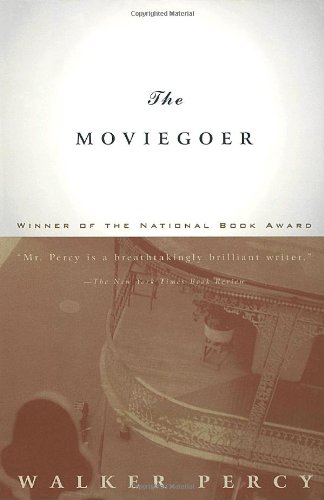
[8] The Moviegoer, by Walker
Percy
In The Moviegoer, Percy tells the story of a man sensitive enough to
be aware of how mired he and is peers are in the heavy “everydayness” of life and of the consequent “possibility of a search”—but socially and
historically dislocated enough from any religious or wisdom tradition that his
sensitivity manifests as a distortion. Sound familiar? Percy taps into the
essential spiritual situation of our post-enlightenment, post-modern world. He has
found something so characteristic of who we are that just his simple
presentation of the situation reverberates with all the mystic power of an
epiphany. Our question is no longer “What are we searching for?” but one prior
to that: “What is the search?”

[9] The Farthest Shore, by Ursula LeGuin
“I set before you life and death. Choose life.” That’s Deuteronomy.
That’s God speaking. Interesting, isn’t it, that God has to tell us which to
pick? You’d think it’d be obvious, but it’s not. Life and death both
argue convincingly for themselves, as anyone whose been depressed or in despair knows. Consequently, life needs to be continually reaffirmed. LeGuin’s
fantasy novel, finds a way to reject the darkness and to accept joy—with integrity.
Anyone who thinks that fantasy cannot be high literature may be embarrassed by
their prejudice after this book. It is a beautiful story that, like life,
argues for itself convincingly if you give it the chance. And so I’ll say no
more. (Except that you may want to read The
Wizard of Earthsea and The Tombs of
Atuan, the first two in the series, in advance.)

[10] Till We Have Faces, by C. S. Lewis
Till We Have Faces
is easily—easily—Lewis’ best work, of his fiction and non-fiction. There is no other
author who deals so charitably and accurately with the theme of self-deception;
neither is there an author who does so as grippingly, entertainingly, or
movingly. The question of suffering, for Lewis, always comes back to self-deception and
the distortion of love. In Till We Have Faces, Lewis shows us how we participate in creating the very
problems we rail against God for, become embittered over—and sell our souls to
have solved our way.
Other Worthy Titles:
The Year of the
Flood, by Margaret Atwood
The Death of Ivan
Illych, by Leo Tolstoy
The Diary of a
Country Priest, by George Bernanos
The Brothers K,
by David James Duncan
Moby Dick, by Herman
Melville
A Prayer for Owen
Meany, by John Irving
The Power and the
Glory, by Graham Greene
Gilead; Home; and Lila, by Marilynne Robinson
Laurus, by Eugene Vodolazkin
Death Comes for the Archbishop, by Willa Cather
The Damnation of Theron Ware, by Harold Frederic
Laurus, by Eugene Vodolazkin
Death Comes for the Archbishop, by Willa Cather
The Damnation of Theron Ware, by Harold Frederic

